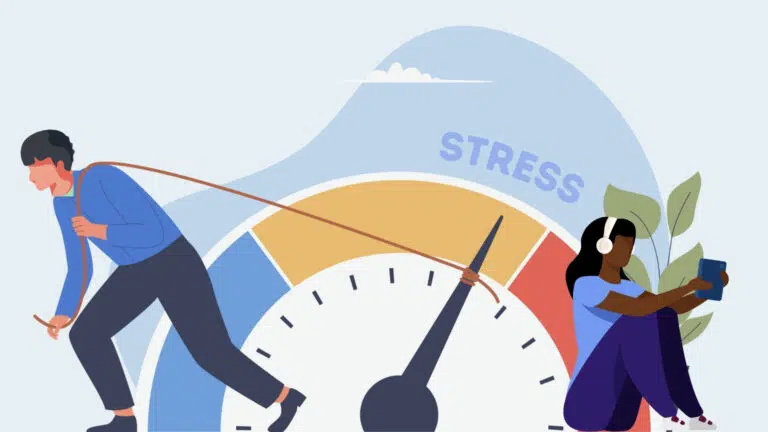

Stress is bad for you, right? It’s bad for your heart, bad for your hair, bad for your skin, and bad for your mood. So, it’s rare to hear anyone singing stress’s praises. Least of all a psychologist. But that’s exactly what psychologist Madelief Falkmann is about to do.
She’s going to explain why stress is important and how you can develop a positive attitude towards stress.
TL;DR: This post is going to go into detail on why stress isn’t always a bad thing and how you can change your perspective towards stress. If you don’t have time to read it all, here’s a short summary.
- Stress is an important tool from our body that helps us to stay out of danger and survive.
- We often see stress as a bad thing, because it has negative effects on our health.
- You can change this perspective and with that reduce the negative effects stress can have.
- See stress as a good thing that helps you instead of works against you.
- Think: This is my body preparing me for a challenge. Your body will believe these thoughts and your stress response will become a lot healthier.
- Also, contact with other people helps to reduce the negative effects because of a hormone (oxytocin) that’s released in the body.
Read on and we’ll tell you everything you need to know about changing your perspective to stress and fears.
Stress has got your back
“From an evolutionary standpoint, stress or fear is an important tool: it warns us of danger and keeps us alert,” explains Madelief. “This increases our chances of survival in the moments when that really counts.”
But even if you don’t get chased by a bear on a weekly basis, stress can help you. If you have a presentation at work or a tight deadline, then a healthy dose of stress will keep you sharp, creative, and efficient. Stress improves your cognitive performance. This means that totally avoiding stress is neither necessary nor even a good idea.
Keep stress in check
Despite this, you’ll still hear doctors say that stress is bad for your health. It makes your heart beat faster while your blood vessels constrict, increasing your risk of cardiovascular disorders.
But what if it wasn’t stress that caused this physical reaction, but your view of stress? In her Ted Talk psychologist Kelly McGonigal explains that your physical response to stress changes as your attitude towards stress changes.
When giving a presentation, your heart will race, your breathing will become more rapid, and your forehead will get sweaty, but you don’t have to interpret these as signs that you aren’t handling the pressure.
Instead, you should see these stress signals as signs that your heart is preparing you to take action, and that your breathing is providing your brain with extra oxygen, so that you’ll have a clearer mind.
And that actually appears to work! A study carried out by Harvard University shows that people who see stress as a good thing are less anxious and more confident. Their physical response to stress also changes: their heart still beats faster, but their blood vessels don’t constrict.
This is the same as the physical reaction you have when you experience joy or courage. “So, that’s very healthy,” says Madelief. “The next time you’re in a tense situation, think to yourself: This is my body, and my body is preparing me for a challenge. Your body will believe these thoughts and your stress response will become a lot healthier.”
Reducing the negative effects of stress
When you do experience stress, it’s possible to reduce its negative effects. One study found that people who experience a lot of stress do indeed have a reduced life expectancy.
“But people who experience a lot of stress and spend a lot of time caring for and helping other people do not experience an increased risk of death at all. That’s due to the substance oxytocin; also known as the cuddle hormone.
When you’re in social contact with other people, you produce a hormone that stops the blood vessels from constricting and that helps your heart to recover after stressful events,” explains Madelief.
“This is further proof that it isn’t stress itself that’s bad for us, but rather our way of looking at and managing stress.”
Learn to embrace your fears
So, what about fear? Are we also able to develop a positive relationship with this? According to Madelief, yes. “We all like to feel that we’re in control of our own lives,” she explains. “But there are many situations where we simply have no influence.
Sometimes stuff just happens. That uncertainty can lead to feelings of anxiety: What if the stock market crashes? What if I get sick? What if my kid gets bullied?”
Madelief: “We have to accept uncertainties as a part of life. Otherwise, we develop an unhealthy relationship with fear. It’s about allowing fear to be present while making conscious choices about how to manage it. Acceptance and Commitment Therapy (ACT) can help you here.
This behavioral therapy helps you to take a flexible approach to the obstacles you encounter (acceptance) and teaches you to stay invested in the things that are important to you (commitment).
During therapy, you run through various processes and skills: Staying present in the here and now, focusing on your values, investing in your values, taking a flexible approach to your self(image), distancing yourself from your thoughts, and accepting unpleasant experiences.
“For people with anxiety, accepting unpleasant thoughts and being able to distance yourself from your thoughts are the most essential skills. You’ll learn to accept that feelings of fear are a part of life and be able to distance yourself from them accordingly,” says Madelief.
A psychologist can help you to develop a healthier relationship with stress and fear. Schedule a consultation.