
Week after week you check off every last item on your to-do list but you still don’t have a lot to show for it – besides countless hours of overtime. Sound familiar? Then it’s time to change your strategy. With the Pareto Principle you can reduce your workload and become more successful. In this article, you’ll learn what the 80/20 rule is all about and how you can use this principle to your advantage.
What is the Pareto Principle (80/20 rule)?
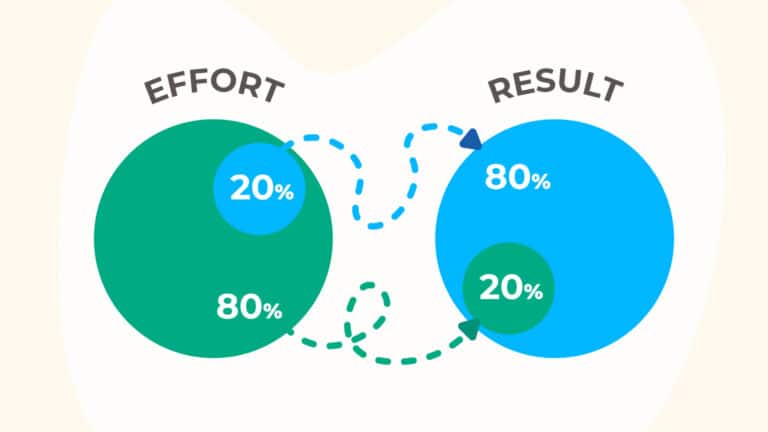
The Pareto Principle is a simple rule that helps us to manage our time better. The 80/20 rule states that 80% of results can be achieved through 20% of our efforts. There’s a simple idea behind this: prioritise tasks and let go of perfectionism. This way you can achieve more in less time. In this article, we’ll explain how this common technique works and how you can incorporate it into your daily working routine.
How to use the Pareto Principle
Many of us struggle to get our priorities straight – at least at work. It’s often much easier in our private lives. Imagine situations like these:
- Cleaning up: An unexpected visitor is arriving this evening and you need to quickly clean up. Obviously, you’ll start with the most important things, like the unwashed dishes in your sink, rather than cleaning out your draws.
- Finances: You’re paying your monthly bills. When doing this you’ll start with the biggest and most important expenses, like your rent, rather than your newspaper subscription.
- Friendships: All of us have a circle of close friends, as well as more distant friends and acquaintances. 80% of the time you’re in contact with 20% of these people.
As you can see, in our private lives we’re often abiding by the Pareto Rule – it just seems like the most logical thing to do. Because if, for example, we expected ourselves to clean our entire homes, including all the windows, whenever anybody dropped by, we’d soon wear ourselves out.
So, why do we find this so difficult at work? In our working lives, it often seems like every task that is given to us is equally important, but we should be asking ourselves more often: what am I accomplishing here? Which of these tasks is going to have the most impact on my company or organisation?
By asking yourself these questions, you can rank your tasks in order of importance and achieve maximum impact for your team. Are you finding it hard to decide which tasks are really important and which are not? If your company works with OKRs, you can use these goals or the company’s mission as a guide.
Tips for the decision-making process
- Identify the biggest problem that your team is currently facing. What could be some possible solutions? You can use the Five Whys Method here.
- Organise your problems into groups. Maybe several of these problems have the same solution.
- Now add a value to each problem. You can use a school grading system or actual monetary figures from the company budget.
- When you’ve done that, you’ll easily be able to recognise which problems fall into that all-important 20% and come up with solutions accordingly.
These problems will often have an impact on other teams or departments within the company. By prioritising these and finding a solution, you’ll increase your own success rate and you’ll start your next working day feeling more motivated.
🙅♂️ If You Don’t Want to Go to Work on Monday, Read This
Some history
As its name would suggest, the Pareto method can be traced back to Italian sociologist and economist Vilfredo Pareto. In 1906, he discovered that 20% of the Italian population owned 80% of the land. Pareto then went on to research the income levels in European and South American countries, developing the social pyramid with poor people at the base and rich people at the top. Since then, the Pareto Principle has mainly been applied to economics.
Advantages of the Pareto Principle
The popular 80/20 rule can help you to quickly become more successful by focusing on the most important 20%. Whether you’re a team leader or employee, the Pareto method has a range of other benefits:
- Large projects and tasks are divided into small steps
- Increased productivity
- Better time management
- Priorities are clear
- Setting boundaries is easier
Common Misconceptions about the Pareto Principle
A common misconception with the Pareto method is that from now on you’ll only have to give 80% and then you can just sit back and chill. That’s sadly not the case, you’ll still definitely have to give 100% at work to be successful. The Pareto principle only encourages you to let go of unnecessary perfectionism and work more efficiently and clearly by prioritising. What the Pareto Principle DOESN’T mean:
- Just ditching unnecessary tasks
- Doing tasks wrong
- Adding 80% and 20% to get 100%
The Pareto Principle states that you can deliver 80% of results with 20% of your effort. However, you still need to accomplish that final 20% of results (the less important tasks).
👩💻 Lacking motivation? Read How to Stay Inspired and Engaged at Work.
How OpenUp can support you
Now that you’ve read this article, you might have a few ideas for how you can improve your time management and work performance. OpenUp can support you even further with the following content and tools:
- 1:1 mental health coaching to clarify your priorities, set boundaries, and work with more focus instead of pressure.
- Group sessions and masterclasses on topics like productivity, resilience, and letting go of perfectionism. Perfect if you want practical tools to put the 80/20 rule into action.
- Mindfulness sessions can help you slow down, take a breath, and stay present when your to-do list feels like too much.
- Self-directed learning with short courses and articles on focus, time management, and well-being.
If you’d like to discuss your individual concerns, then you can schedule a consultation with one of our psychologists.
Want to work smarter, not harder?
FAQs about The Pareto Principle
What is Pareto’s Principle in simple words?
Pareto’s Principle means that a small part of what you do leads to most of your results. In everyday life, just a few tasks, habits, or relationships have the biggest impact on how you feel and what you get done. When you notice which ones matter most, it becomes easier to focus your energy and feel less stressed.
How does the 80/20 rule work?
The 80/20 rule helps you see where your effort really counts. Instead of trying to do everything perfectly, you focus on the few actions (20%) that give you most of your results (80%). It could be a task that helps your team, a conversation that strengthens a friendship, or a habit that boosts your mood. When you know what matters most, it’s easier to choose your next step and feel more in control.
How to apply the 80/20 rule in life?
Start by looking at your day. Which activities give you the most progress or joy? Which ones leave you tired without much result? If you focus more on the few things that matter most at work, with people, or in your routines, you’ll have more space and energy. Small, thoughtful choices can lead to real change.
What is an example of the Pareto Principle in real life?
A simple example is friendships. You might know many people, but a small group gives you most of your support and connection. At work, one or two main tasks often move your projects forward, while many smaller tasks can wait. Seeing these patterns helps you set priorities and feel less pressure.