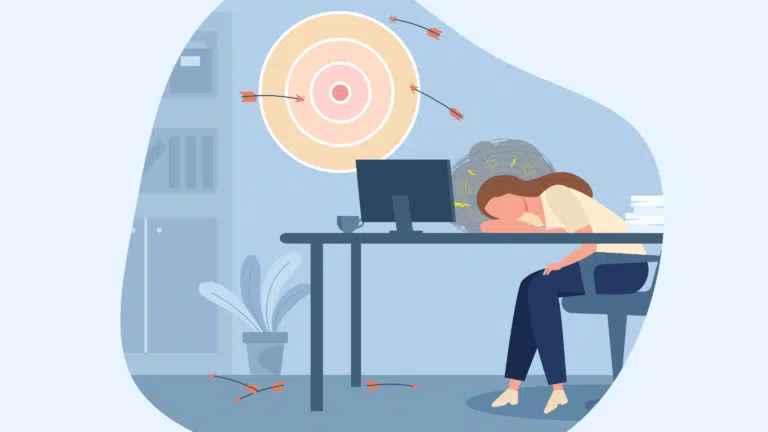

However candid, sociable or extroverted you are, talking to your manager (or your manager’s manager) isn’t always easy. Do you feel like your heart is in your mouth as soon as your manager adds a check-in to your calendar? Or do you have no idea what to say when you find yourself standing alone with a superior at the coffee machine? In this guide, you’ll learn why that is and what you can do in these situations. In other words, how to deal with them.
Being able to confidently have a good conversation with your superiors or managers will help you to advance your career and give your self-confidence a boost. Psychologist Britt Slief explains how to go about it.
Why do we find it so hard?
Does your manager want to speak to you because you’ve done something wrong or is it just a meeting to check in on how you’re doing? And what in the world are you going to do about it?
“It’s totally normal for a scheduled or unexpected conversation with your manager to bring up feelings of uncertainty or discomfort,” confirms Britt.
“From an evolutionary perspective, feelings of anxiety exist to help you in acutely stressful situations when you’re in danger. They prepare you to react appropriately. Think of a predator approaching you while you’re looking for something to eat,” she explains.
“It’s totally normal for your brain to respond by protecting you. Feelings of anxiety make sure that you take action and run away to safety.”
So, that’s very useful. At least it was, back in our days on the prairie. But that’s not the case in situations that aren’t acutely dangerous, such as conversations with your manager.
The dangers we face these days aren’t as life-threatening as they were back then. They generally require a different approach, although our brains still work in the “old way”.
“So, this means that your automatic reaction to a conversation with your manager actually works against you. It makes you nervous, although in most cases there’s nothing to be afraid of”, says Brit. “That’s not a bad thing, but it’s good to know how to deal with this.”
How to handle your nerves before a talk with your manager?
Whether you have an issue you want to raise, it’s a monthly check-in or you’re just having a chat – conversations with your manager (or your manager’s manager) can make you nervous.
But you can learn how to manage these nerves. Britt advises:
- Be conscious of your feelings. Acknowledge them and know that it’s just an automatic response from your body. This awareness alone will give you more control over the situation.
- Challenge your thoughts. Ask yourself critical questions about the situation. Ask yourself if what you’re thinking is really true. And what’s the worst that could happen?
- Talk positively about the outcome. Replace your critical thoughts with positive ones. And especially do this for your thoughts about your efforts related to the conversation. Don’t say: “what if it becomes a difficult conversation”. Instead say: “I’ll do my best to make it a good conversation.”
- Think about how it will benefit you. Shift your focus away from the tension surrounding the conversation to how the conversation will benefit you. For example, the conversation might create a better bond between you and your manager. But it’s also good to let other people know what’s on your mind and what your challenges are at work. Your manager is the best person to help you here.
Also, remember that your manager is just a person. A person who also sometimes gets nervous or uncomfortable, or who doesn’t know what to say.
So, then what? There are various things you can do, depending on the type of conversation. Britt advises:
How to raise an issue
-
Choose a good moment. Do you like having conversations in the morning because you’re still fresh and energetic? Or do you prefer to have them at the end of the day because you’re more prepared? Choose a moment that works for you and when you have enough time. So, don’t try to just squeeze it in during the five minutes before a meeting.
-
Write down what you want to say and what you’d like to be the outcome of the conversation, or possible solutions. It also helps to practice the conversation. Do this with someone you trust, such as a friend or colleague, or write it down for yourself.
-
Discuss it with other people. It always helps to talk openly about your thoughts with people you trust. They can help you to have a conversation or get your thoughts straight. A psychologist can also help you here.
-
Speak from your experience. As with any conversation, it’s better to speak from your own perspective. How do things come across to you and how do you feel about them? Don’t put words into other people’s mouths, but explain how things seem to you.
-
See the conversation as a win-win. You want to address this issue, not only so you can do a better job, but also for the benefit of your manager, your team and the organisation.
How to handle feedback from your manager
-
Actively listen. Try to understand what’s being said, instead of immediately responding with an answer or argument. Listen to understand, not to respond.
-
Ask questions. Ask why, what and how questions related to the feedback. This will help you to understand where it’s coming from and how you can improve.
-
Know that you don’t always have to agree with your manager. Your manager has an opinion. You have an opinion. And that’s okay. You don’t have to agree about everything. Not sure what to think yet? Clarify that it’s got you thinking and you’re going to figure out if there’s anything you can do about it. You can always come back later.
-
Return to it. Feedback exists so that you can get better at what you do. Feel free to check in with your manager later to see if you’re making progress yet or if there’s anything extra you can do.
What if an unexpected meeting pops up?
-
Calm your nerves. The tips above (about nerves) will help you here.
-
Be open about it. There’s a good chance your manager doesn’t realise this unexpected meeting is scary for you. Speak to your manager or shoot them an email saying that you’re curious about what’s happening and that you’d like to prepare in advance.
-
Don’t forget that it’s okay to feel tense. That’s just how it goes sometimes. After all, you don’t know what to expect.
-
Make the meeting as comfortable for yourself as possible. Grab a cup of tea. Go for a little walk before the meeting to clear your head. Promise yourself that you’ll go and get something sweet afterwards, or do something else fun.
Your manager is there to help you
And remember: your manager is there to help you in both your work and your personal growth. Nerves are understandable, but never necessary.
What’s more: you’ve been employed for your skills and great personality.
Everyone will appreciate you entering these conversations with confidence. Your vision, ideas and work matter. This realisation can help take some of the pressure off.
Some other articles that you might find interesting:
💡 How To Say “No” (and Why We Find It So Hard)