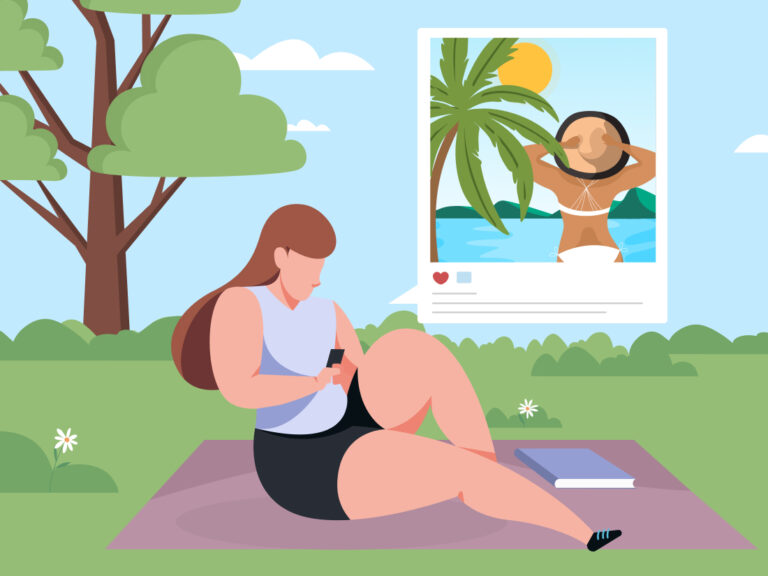
Picture this: it’s a sunny summer’s day and you’re reading a book in the garden while the sun warms your face. Pure relaxation, right? But then you quickly glance at your phone and end up scrolling on social media. And there it is: a picture from a tropical beach, a city trip, the view from an airplane window. It seems like everyone is on holiday, and you think: here I am, at home. Suddenly, your peaceful moment doesn’t feel so relaxing anymore. What if you’re missing out on something?
This exact feeling describes the phenomenon known as FOMO – the “Fear of Missing Out”. In this article, you’ll learn what’s behind it, why we’re so susceptible to FOMO, especially during vacation time, and what you can do to manage it better.
What exactly is FOMO?
FOMO is an acronym for ‘’the Fear of Missing Out’’ – especially used when you see others experiencing something enjoyable, exciting, or meaningful. In the digital age, this feeling is everywhere: on social media, we constantly see what others are doing and quickly feel like we’re not experiencing enough ourselves or that we don’t belong. FOMO can rear its head at any time, but it often happens in the summer, due to comparison, and ironically, it can also happen when you’re on holiday. For example, you might be relaxing by the pool, but then you see videos of adventurous holidays filled with jet-skiing and skydiving. You might then feel a new pressure arising: am I doing enough?
FOMO can be fleeting – like a brief sting while scrolling – or develop into a burdensome, ongoing state. People with strong FOMO tend to experience loneliness, social inferiority, or a sense of exclusion more often. A common sign is an urge to stay constantly online and up to date to avoid missing anything.
How FOMO affects us
At its core, FOMO stems from a deeply human need: social belonging. The psychological self-determination theory identifies social connectedness as a key factor for motivation and mental well-being. When this need isn’t met – because we feel excluded or “less successful” than others – negative emotions like dissatisfaction, insecurity, or anxiety arise.
Social media intensifies this effect by showing us in real time what others are experiencing, celebrating, or achieving – usually filtered, edited, and idealised. Online content is almost always positively biased. According to the psychological theory of self-discrepancy on social media, we often present an idealised version of ourselves (the “ideal self”) while our real self (“actual self”) remains hidden. This gap can lead to frustration when we compare ourselves to these seemingly perfect lives. Studies show that social comparison is one of the strongest predictors of FOMO.
💡 Tip: Check out our course Breaking the Comparison Cycle: You’ll learn how comparisons have changed in the digital age, recognise your own comparison patterns and triggers, and discover how your personal values can consciously influence your actions. ➡️ Explore the course
The brain’s reward system also plays a role: likes, messages, or new content activate the so-called mesolimbic dopamine pathway – a key neural circuit responsible for processing reward, motivation, and pleasure. This motivates us to keep checking our phones, out of fear of missing out and in the hope of connection. FOMO is therefore not a superficial phenomenon, but a complex interplay of psychological needs, social dynamics, and digital habits. And that’s exactly why it affects so many of us so deeply.
Why is FOMO Especially Present During Summer Time?
Summer vacation is meant for relaxing and recharging. But social media can create the pressure to “perform” even while on holiday: to have as many great experiences, beautiful photos, and new adventures as possible. If you decide to stay home or enjoy quiet days, it’s easy to think: “Everyone is experiencing more than I am.”
But: just because you’re not traveling doesn’t mean your vacation is any less valuable.
Rest isn’t a performance. And comparisons often cloud your awareness of what you truly need.
5 Tips to Combat FOMO
Here are a few suggestions that can help you better cope with FOMO, both in summer and year round:
1. Ask yourself: What do I really need right now?
Do you genuinely want to experience something at this moment, or do you just feel like you have to? FOMO often tricks us into thinking that being active equals worth. But sometimes, what you simply need is time to relax and recharge.
💡 Try this: Next time you feel the urge to do something just because others are, pause and do a quick “needs check-in”:
- What am I hoping this experience will give me?
- Do I need excitement, connection, or calm right now?
- Is there a simpler way to meet that need today?
2. Experience Consciously – Instead of Perfectly
Your life doesn’t need to be perfect to be meaningful. Appreciating small moments matters, whether that’s reading a good book, going for a walk, or enjoying a conversation with a loved one. They might not seem spectacular on social media, but they can be exactly what truly strengthens you from within.
💡 Try this: Pick one ordinary moment in your day – your morning coffee, a walk, a quiet break – and give it your full attention. No multitasking, no scrolling. Just be in that moment.
Want to go one step further? At the end of the day, write down one thing you enjoyed that you didn’t post about. Over time, this simple habit helps shift your focus from performance to presence.
3. Practice Mindfulness
Studies show that mindful awareness and self-compassion help reduce FOMO. FOMO begins in the mind: it distorts our perception and influences our behaviour. Mindfulness helps you stay in the here and now – observing your thoughts and feelings without immediately judging them.
Mindfulness creates a moment of pause between stimulus and response, and it’s exactly this space that helps you avoid automatically reaching for your phone or getting lost in comparisons.
💡 Tip: If you want to learn more about mindfulness, check out our resources on self-care and mindfulness.
4. Take Social Media Breaks & Find What Fills the Gap
Taking intentional social media breaks helps create space to reconnect with your own life instead of constantly comparing it to others’. But quitting the scroll cold turkey can be tough, especially if it’s tied to your routine. Rather than relying on willpower alone, try replacing it with something that meets a similar need, like texting a friend, journaling, or stepping outside. You’re not just disconnecting; you’re re-routing your attention toward something more grounding and real.
💡 Tip: Join our 7-day wellbeing challenge – and discover how to make your relationship with social media healthier, more mindful, and more relaxed.
5. Discover JOMO – the joy of missing out
JOMO is the counter-movement to FOMO – the joy of missing out. It’s about consciously switching off sensory overload, finding inner peace, and deciding for yourself what feels good. Not withdrawing, but deliberately choosing what you want to experience and share – and what you don’t.
💡 Example: You’re invited to a party, but after a long week, you choose a quiet night in with your favourite meal and a film. Not out of fear, but because rest feels right. That’s JOMO: choosing what you truly need over what you think you’re supposed to do. Try it yourself!
Your Summer, Your Way
You don’t have to prove anything – not to yourself or the internet. Everyone has different needs. Whether you’re travelling or staying home, you deserve to enjoy what feels right for you in the moment.
Because if you’re constantly checking what others are doing, you might miss the most important thing: The moment you’re actually living in right now.
And that moment, no matter how ordinary it seems, can be the most precious one.